

Why Japanese Consumers Are Looking for Better Pillows: Opportunities for Ergonomic Pillow Brands
Nov 12, 2026
Leave a message
Japanese consumers are paying increasing attention to whether their pillows match their individual sleeping preferences. For bedding brands, this creates an opportunity to develop more differentiated pillow collections based on comfort preferences, support requirements, material selection, and product functionality.
According to the Pillow White Paper 2026, published by Japanese pillow company Makura Corporation, 64.8% of surveyed respondents reported some level of dissatisfaction with their current pillows, while 34.0% considered themselves unable to find a suitable pillow. The findings suggest that product fit remains an important issue in the Japanese pillow market.
For international bedding brands, importers, and wholesale buyers, the opportunity is not simply to introduce another pillow material. It is to develop products with clearly defined design features and specifications that address different consumer preferences.
This article examines Japanese consumers' pillow-related concerns, key ergonomic design factors, material options, and sourcing considerations for brands planning customized pillow collections.
Japan's Pillow Market: Why Product Fit Is Becoming a Key Issue
Pillows are already an established part of everyday bedding in Japan. The Pillow White Paper 2026 reported a pillow usage rate of 93.6% among its surveyed respondents. However, widespread usage does not necessarily mean that existing products meet individual expectations.
The report also found that:
64.8% of respondents had some dissatisfaction with their current pillows.
34.0% identified themselves as people struggling to find a suitable pillow.
61.5% had tried four or more pillows during their lifetime.
31.9% did not know their preferred pillow height.
23.6% did not know their preferred pillow firmness.
These findings highlight a product-development challenge: consumers may have difficulty identifying the pillow specifications that suit their preferences.
For bedding brands, this creates opportunities to build product collections around clearly differentiated height options, firmness levels, support structures, and material characteristics.
The figures above come from the publisher's 2026 report, which includes both pillow-interested respondents recruited through online pillow assessment services and a separate general-consumer online survey. They should be interpreted as survey findings rather than a definitive measurement of every Japanese consumer.
What Japanese Consumers Are Dissatisfied With in Their Current Pillows
Understanding the reasons behind pillow dissatisfaction helps brands move beyond generic product claims and develop more targeted product specifications.
Uncertainty About Pillow Height and Firmness
A pillow that feels too high, too low, too soft, or too firm may not match an individual's preferred sleeping position and comfort expectations.
The 2026 report found that some respondents were unsure about their preferred pillow height or firmness. This suggests that brands should consider offering clearly differentiated specifications instead of relying on a single standard design.
For product development, relevant options include:
- Multiple pillow height profiles.
- Different firmness configurations.
- Adjustable or interchangeable filling systems, where applicable.
- Clear product descriptions explaining the intended feel and structure.
Insufficiently Defined Support Areas
Pillow buyers may look for different levels of support around the head, neck, and shoulders. A uniform pillow profile does not necessarily meet every user's preferences.
The report found that 54.9% of respondents wanted neck support. This makes support structure an important consideration for brands developing ergonomic pillow collections.
Product teams can evaluate contoured profiles, differentiated support zones, and combinations of materials with different physical properties.
Difficulty Turning During Sleep
A pillow should be considered in terms of how it is used throughout the night, not only how it feels when someone first lies down.
According to the report, 79.9% of respondents wanted a pillow that made turning during sleep easier.
For brands, this points to the importance of evaluating pillow width, surface structure, edge design, and the transition between different support areas.
Material Deterioration and Maintenance
The report also identified pillow deterioration and hygiene concerns among the reasons respondents replaced their pillows. The most frequently reported replacement reason was loss of shape or flattening, at 36.4%. Stains, discoloration, and odors accounted for another 23.9%.
These findings make material performance and maintenance relevant sourcing considerations.
Brands should assess shape retention, material consistency, cover construction, cleaning instructions, and the suitability of the pillow structure for its intended use.
Five Design Factors Behind Ergonomic Pillow Development
Consumer concerns become commercially useful when they are translated into measurable product specifications. For bedding brands, the following five factors provide a practical framework for developing ergonomic pillow products.
Pillow Height and Profile
Pillow height affects the overall sleeping experience and should be evaluated together with pillow shape, material structure, and intended user preferences.
Brands can consider developing:
- Low-profile pillow designs.
- Medium-height and higher-profile options.
- Contoured designs with different height zones.
- Adjustable constructions, depending on the selected filling system.
For OEM and ODM projects, buyers should confirm finished dimensions, height measurements, dimensional tolerances, and sample consistency before bulk production.
Firmness and Support
Firmness is not the same as support. A pillow may feel soft on the surface while having a different level of underlying resistance.
Product development should therefore consider material density, structural design, compression behavior, and the intended firmness category.
Buyers can request samples with different material formulations or structural configurations to compare the actual feel before confirming a production specification.
Neck and Head Support
Ergonomic pillow designs may use contoured shapes or differentiated support areas to create a more defined product structure.
Depending on the target product, brands can explore cervical contour pillows, shaped memory foam pillows, or TPE grid structures combined with other support components.
The final design should be evaluated through physical samples and product testing. Ergonomic positioning should not be presented as a medical treatment or a guaranteed solution for neck or shoulder problems.
Ease of Turning During Sleep
Turning comfort depends on more than one material property. Pillow dimensions, surface construction, edge shape, and the transition between support areas can all influence the user experience.
Brands should evaluate whether the pillow maintains a consistent and usable surface across different sleeping positions.
For example, a reversible pillow design can provide two different surface experiences within one product, giving brands another way to differentiate their collections.
Hygiene and Maintenance
Cleaning requirements are important for both consumers and retailers. The pillow core, cover fabric, zipper construction, and care instructions should be considered together.
Before sourcing, buyers should confirm:
- Whether the cover is removable.
- Whether the cover is machine washable.
- Whether the pillow core can be washed or requires spot cleaning.
- Whether the material is compatible with the stated care instructions.
- Whether replacement covers can be supplied.
Care claims should always match the actual material properties and product test results.
TPE and Memory Foam: Two Material Options for Different Pillow Concepts
TPE and memory foam offer different material characteristics and can support different product-development strategies. They should not be treated as interchangeable materials or compared using unsupported claims.
TPE Pillow: Open-Grid Structures and Design Flexibility
TPE pillows can be developed with grid-based structures that create a distinctive internal construction.
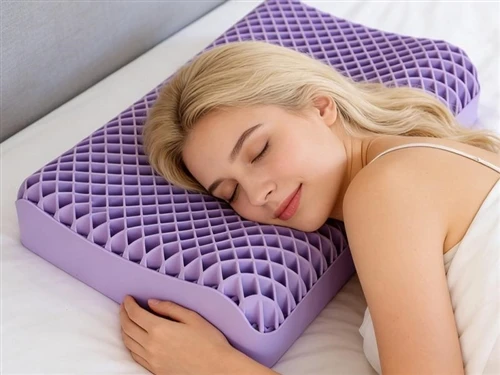
For example, a TPE grid pillow uses an open three-dimensional structure rather than a conventional solid foam block. Its grid geometry, material formulation, and supporting components can be evaluated together to define the intended feel and product performance.
Potential development directions include:
- TPE polymer grid pillows.
- Honeycomb-style TPE pillow structures.
- Reversible pillows with different surface experiences.
- TPE structures combined with other support components.
RINA's TPE Polymer Grid Pillow is one example of this product direction. Its design combines an open-grid TPE structure with a supporting pillow construction. The reversible design provides a TPE grid side and a smoother surface on the other side.
For buyers, important evaluation points include grid geometry, material consistency, structural recovery, finished dimensions, and the interaction between the TPE component and other pillow materials.
Memory Foam Pillow: Contoured Shapes and Form-Based Design
Memory foam pillows provide another product-development route, particularly for brands interested in shaped and contoured pillow designs.
Depending on the foam formulation and product construction, manufacturers can develop different pillow profiles, dimensions, and firmness options.
Potential product directions include:
- Contoured memory foam pillows.
- Cervical-shaped pillows.
- Cloud-style memory foam pillows.
- Customized pillow shapes for specific brand collections.
For sourcing projects, buyers should evaluate foam density, firmness, dimensional consistency, compression recovery, odor characteristics, and the stability of the finished product.
Choosing the Right Material for a Product Collection
| Development consideration | TPE pillow | Memory foam pillow |
|---|---|---|
| Main design direction | Open-grid and structured designs | Solid foam and contoured designs |
| Product differentiation | Grid geometry and surface construction | Shape, profile, and foam formulation |
| Design flexibility | Grid patterns and structural combinations | Molded shapes and contour variations |
| Key sourcing checks | Grid consistency, recovery, dimensions | Density, firmness, recovery, dimensions |
| Suitable development approach | Grid-based and reversible concepts | Contoured and profile-based concepts |
The right material depends on the brand's target positioning, desired product structure, cost requirements, and testing criteria. Buyers should compare actual samples rather than making purchasing decisions based on material names alone.
Ergonomic Pillow Designs That Bedding Brands Can Develop
Instead of relying on one universal pillow design, brands can build product collections around different consumer preferences and functional concepts.
TPE Grid Pillow
An open-grid TPE structure creates a recognizable product design that can help brands differentiate their pillow collections.
Development considerations include grid shape, grid dimensions, material formulation, pillow profile, and supporting components.
Reversible TPE Pillow
A reversible design offers two different surface experiences within one product.
For example, RINA's TPE Polymer Grid Pillow combines a TPE grid side with a smoother reverse side. This design gives brands an additional product feature to communicate without introducing an entirely separate pillow model.
Contoured Memory Foam Pillow
A contoured memory foam pillow can be developed with shaped support areas and different profile configurations.
Brands can explore variations in height, contour geometry, firmness, and overall dimensions to create distinct product models.
Customized Ergonomic Pillow Collection
For brands planning a wider range, product differentiation can be achieved through several specifications:
- Pillow height and dimensions.
- Material selection and formulation.
- Firmness configuration.
- Contour and structural design.
- Cover fabric and construction.
- Color, labeling, and packaging.
The goal is to build a product range with clear differences between models, rather than producing multiple versions with almost identical specifications.
What Importers and Wholesale Buyers Should Evaluate Before Sourcing
For bulk pillow procurement, the appearance of a sample is only one part of the evaluation. Buyers should establish measurable specifications and quality requirements before confirming an order.
Material Specifications
Confirm the material type, formulation, component composition, and relevant supplier documentation.
For TPE pillows, buyers should examine the consistency of the grid structure and material properties. For memory foam pillows, density, firmness, and dimensional stability are important evaluation points.
Product Dimensions and Tolerances
Specify finished length, width, height, weight, and acceptable dimensional tolerances.
For contoured or grid-based pillows, buyers should also confirm the measurements of key structural areas.
Sample Evaluation
Samples allow buyers to assess the actual product before committing to mass production.
A practical evaluation process may include:
- Reviewing the initial product sample.
- Checking dimensions, appearance, and material consistency.
- Comparing firmness and compression behavior.
- Evaluating the cover and assembly.
- Confirming revisions before approving the production sample.
Quality Control and Testing
Buyers should establish inspection requirements according to the product type and target market.
Relevant checks may include appearance inspection, dimensional measurement, material consistency, compression and recovery evaluation, cover stitching, zipper performance, and packaging inspection.
Any additional laboratory testing or certification requirements should be agreed upon according to the target market and product specification.
Packaging and Logistics
Pillow packaging affects storage, transportation, retail presentation, and product protection.
Buyers should confirm packaging dimensions, compression requirements where applicable, carton specifications, labeling, and shipping marks before production.
For compressed products, the buyer and manufacturer should also agree on the recovery period and evaluation method after unpacking.
OEM and ODM Opportunities for Customized Ergonomic Pillows
For bedding brands and private-label businesses, OEM and ODM cooperation provides a way to develop pillow products around their own market positioning.
OEM projects generally follow the buyer's existing product design and specifications, while ODM projects may involve manufacturer support in developing the product structure and design.
Depending on the project, customization may cover:
Pillow dimensions and height.
- TPE grid structure or memory foam contour.
- Material combinations and firmness configurations.
- Custom mold development.
- Removable covers and fabric selection.
- Brand labels, logos, and packaging.
- Product samples and specification adjustments.
Before mass production, buyers should confirm the approved sample, technical specifications, quality standards, packaging details, MOQ, production lead time, and applicable testing requirements.
For new product concepts, it is particularly important to clarify mold ownership, mold development costs, revision procedures, and the responsibilities of each party.
How RINA Supports Pillow Product Development and Bulk Supply
Zhejiang Rina Home Technology Co., Ltd. develops and supplies TPE pillows, TPE mattresses, TPE cushions, and memory foam pillows for international bedding brands and buyers.
Rather than focusing on a single pillow model, RINA supports different product directions through material selection, product structure development, customization, and manufacturing coordination.
TPE and Memory Foam Product Development
RINA's product range includes TPE grid pillow designs and memory foam pillow products. This gives buyers options when developing collections with different materials, structures, and product positioning.
For example, buyers can evaluate open-grid TPE structures, reversible pillow concepts, and customized memory foam contours according to their product requirements.
OEM and ODM Customization
RINA supports OEM and ODM projects involving product specifications, structural design, custom mold development, and packaging.
Depending on the project, buyers can discuss dimensions, product shapes, material configurations, covers, labels, and retail packaging.
Manufacturing Capacity for TPE Products
RINA's stated production capacity reaches up to 200,000 TPE pillows per month and 20,000 TPE mattresses per month.
These figures refer to TPE product capacity, not memory foam pillow capacity. Actual output and lead time should be confirmed according to the product model, order quantity, customization requirements, and production schedule.
Quality and Compliance Documentation
RINA works with relevant management and product compliance documentation, including BSCI, OEKO-TEX, CertiPUR-US, REACH, and ISO 9001-related credentials.
The applicability of each certificate or document depends on the product, material, facility, and project scope. Buyers should confirm the relevant certificate number, validity, issuing body, and product coverage during supplier evaluation.
For bedding brands planning customized TPE or memory foam pillow collections, RINA can discuss product concepts, sample development, customization requirements, and bulk production arrangements.
Frequently Asked Questions
Q: What Should Bedding Brands Consider When Developing Ergonomic Pillows For The Japanese Market?
A: Brands should evaluate pillow height, firmness, support structure, sleeping-position preferences, material selection, and maintenance requirements. Product specifications should be based on target-customer research and physical sample evaluation.
Q: What Is The Difference Between TPE Pillows And Memory Foam Pillows?
A: TPE pillows can use open-grid structures and different structural configurations, while memory foam pillows are commonly developed through solid foam constructions and contoured profiles. Their actual performance depends on material formulation, product geometry, and manufacturing quality.
Q: Can TPE Pillows Be Customized For Private-Label Brands?
A: Customization may include grid structure, pillow dimensions, supporting components, cover design, branding, and packaging. The available options should be confirmed with the manufacturer according to the project requirements.
Q: Can Manufacturers Develop Custom Memory Foam Pillow Shapes?
A: Yes. Custom memory foam pillow projects can involve contour design, dimensions, foam specifications, mold development, covers, and packaging. Buyers should review samples and confirm the technical specifications before bulk production.
Q: What Documents Should Buyers Request When Sourcing Pillows?
A: Buyers should request relevant material specifications, product test reports, quality inspection records, and applicable certificates. They should verify that each document covers the actual product, material, or manufacturing facility involved in the order.
Q: Does RINA Support OEM And ODM Pillow Projects?
A: RINA supports OEM and ODM cooperation for TPE and memory foam pillow products. Project discussions can cover product design, customization, mold development, samples, branding, and packaging.
Develop Your Custom Ergonomic Pillow Collection with RINA
If your brand is planning a TPE or memory foam pillow collection, contact RINA to discuss product specifications, sample development, OEM/ODM customization, and bulk production requirements.