

How To Develop A High-Performance Cooling Pillow: Materials, Testing, And OEM Manufacturing Guide
Oct 19, 2026
Leave a message
Cooling pillows are becoming an important product development opportunity for bedding brands seeking to differentiate their sleep product collections. However, developing a high-performance cooling pillow requires more than adding a cooling fabric or gel layer to a conventional pillow. Material selection, internal structure, airflow, ergonomic support, durability, and manufacturing consistency all influence the final product.
For brands, importers, and private-label buyers, the challenge is to turn a cooling concept into a product with measurable performance, repeatable quality, and a commercially viable production process.
This guide explains the main cooling technologies, how to evaluate thermal performance, and what buyers should consider when developing a customized cooling pillow with a manufacturing partner.
What Defines a High-Performance Cooling Pillow?
A cooling pillow is designed to improve the thermal comfort of the sleeping surface through material selection, structural design, or a combination of both.
For product developers, cooling performance should not be evaluated as a single feature. A commercially successful pillow must balance several requirements.
Initial cool-touch sensation: The temperature-related sensation when the surface first contacts the skin.
Thermal management: How heat transfers through and accumulates within the pillow during use.
Airflow and ventilation: How the material and internal structure support air movement.
Ergonomic support: Whether the pillow provides appropriate height, resilience, and pressure distribution.
Durability: Whether the pillow maintains its structural integrity and functional properties after repeated use.
Manufacturing consistency: Whether production batches can reproduce the approved sample and agreed specifications.
These factors are related but not interchangeable. A surface that feels cool immediately may not maintain the same sensation during prolonged use. Likewise, an open structure does not automatically guarantee a lower sleeping temperature.
For brands planning a new product, the first step is to define the intended user experience and identify which performance requirements need objective verification.
RINA's experience in TPE sleep product manufacturing provides a starting point for projects involving resilient materials, open-grid structures, and customized pillow configurations. The appropriate construction still needs to be determined according to the specific product requirements.
Cooling Pillow Materials and Their Functions
Selecting the right materials requires an understanding of their individual functions and how they interact within the finished product.
Cooling Fabrics and HMWPE-Based Materials
The cover is the first point of contact between the user and the pillow. Its surface texture, thermal properties, moisture management, and durability influence the initial sleeping experience.
Some cooling fabrics incorporate high-molecular-weight polyethylene (HMWPE), while others use specially engineered synthetic fibers or textile blends to achieve a cool-touch sensation.
When selecting a cover, buyers should evaluate:
- Fiber composition and fabric construction.
- Contact-cooling performance under a defined test method.
- Breathability and moisture management.
- Skin-contact comfort and surface texture.
- Washability, dimensional stability, and colorfastness.
- Compatibility with the selected pillow core.
RINA's published OEM/ODM capabilities include fabric and cover customization, with options such as cooling fabrics, breathable mesh, knitted covers, and removable zippered designs. This provides flexibility when matching the cover to the intended product positioning.
However, the performance of a particular HMWPE fabric or specialized cooling textile should be confirmed through material documentation and appropriate testing rather than inferred from its name alone.
Memory Foam and Alternative Pillow Cores
Memory foam is commonly used in ergonomic pillows because it can conform to the user's head and neck and distribute pressure. Its thermal behavior depends on the formulation, density, cell structure, ventilation, and overall construction.
Alternative options include ventilated foam, TPE structures, and hybrid designs.
For buyers, the choice should reflect the intended balance between support, resilience, airflow, cost, and manufacturability.
RINA specializes in TPE sleep products and also lists memory foam products within its broader product range. This creates a basis for discussing alternative core materials, although the feasibility of combining specific materials in a single customized pillow must be assessed separately.
The development team should compare candidate materials against defined support and thermal requirements instead of assuming that one material is suitable for every application.
TPE Structures for Airflow and Resilient Support
Thermoplastic elastomer (TPE) is used in pillow designs requiring elasticity, resilience, and a structured internal form.
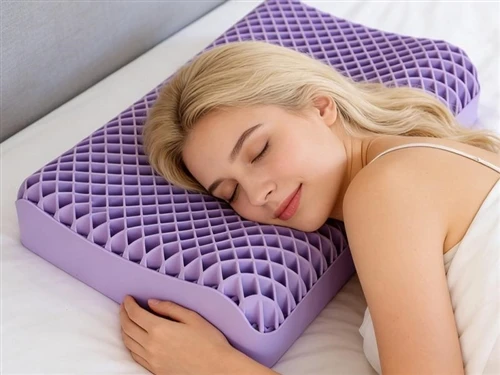
Open-grid and honeycomb TPE structures create spaces within the pillow core that may support air movement. Their effectiveness depends on grid geometry, opening dimensions, material thickness, compression under load, and the surrounding cover.
Key evaluation criteria include:
- Honeycomb geometry and structural stability.
- Hardness, resilience, and recovery after compression.
- Pillow height and support characteristics.
- Dimensional consistency between production batches.
- Compatibility with the selected cover and additional layers.
- Cleaning and maintenance requirements.
RINA's TPE manufacturing capabilities include material processing, hardness adjustment, molding, structural customization, and mold development. Its OEM/ODM services support projects requiring adjustments to pillow height, firmness, internal structure, and other product specifications.
These capabilities are relevant when a buyer needs a TPE pillow developed beyond an existing standard configuration.
Nevertheless, TPE should not be described as a guarantee of continuous cooling. The complete pillow must be evaluated under appropriate conditions to establish its actual thermal performance.
Cooling Gel and Phase-Change Materials
Cooling gels and phase-change materials (PCM) are additional technologies that may be considered during product development.
Cooling gels can influence heat transfer and surface sensation, depending on their formulation and placement. PCM materials absorb or release heat as they change phase within a defined temperature range.
Their contribution depends on factors such as material quantity, thermal properties, integration method, and operating conditions.
Before adding these components, manufacturers and buyers should consider material compatibility, attachment methods, durability, safety documentation, processing requirements, and cost.
For RINA-led development discussions, these technologies should be treated as potential options requiring technical evaluation. Their availability and compatibility with a particular TPE pillow structure should be confirmed before a development commitment is made.
How Pillow Structure Influences Heat Management
The arrangement of materials is as important as the materials themselves. A well-designed structure must support the intended thermal performance without compromising comfort or durability.
Open-Grid and Honeycomb Structures
Open-grid designs create interconnected spaces within a pillow core. Depending on the geometry and compression during use, these spaces may facilitate airflow and help reduce heat accumulation.
Important design variables include opening size, grid thickness, overall pillow height, elasticity, and compression behavior.
RINA develops customized TPE pillow structures and supports mold development for different product configurations. These capabilities can help buyers explore structural variations instead of relying exclusively on changes to the outer fabric.
During prototype evaluation, the structure should be assessed under representative loading conditions because its behavior when unloaded may differ from its behavior during sleep.
Hybrid Pillow Construction
A hybrid pillow may combine a TPE core, memory foam comfort layer, specialized cover, or other functional components.
Such constructions can provide more flexibility in balancing support and surface comfort, but additional layers may also change airflow, thermal resistance, weight, and manufacturing complexity.
Each component should have a defined function. A more complex design is not necessarily a better design.
For OEM/ODM projects, RINA can assess the proposed TPE structure, customization requirements, and manufacturing process. Whether a particular multilayer design can be produced using existing equipment or requires additional tooling and external technical support must be confirmed during project evaluation.
Structural Customization and Tooling
Custom dimensions, ergonomic contours, and modified honeycomb geometries may require adjustments to existing molds or the development of new tooling.
Before approving a design, buyers should clarify the relationship between structural changes, tooling costs, sampling schedules, and mass production.
RINA's published manufacturing information identifies mold development, prototype sampling, and structural customization as part of its TPE product development capabilities. This is particularly relevant for brands seeking differentiated TPE pillow designs rather than simple logo customization.
Cooling Performance Testing and Product Validation
Objective testing helps brands evaluate product performance and substantiate cooling-related claims.
No single measurement fully describes the thermal experience of a finished pillow. A suitable testing plan may combine material-level tests with finished-product assessments.
Q-max or Equivalent Contact-Cooling Measurements
Q-max is commonly used to characterize the maximum transient heat-transfer response when a warmer measuring surface contacts a cooler textile surface under specified conditions.
A higher value generally indicates a stronger initial cool-touch response under the applicable test method. It does not independently establish sustained cooling performance.
Buyers should request the test method, specimen details, measured results, and testing conditions when comparing materials.
Surface Temperature Measurements Over Time
Surface temperature measurements can show how a pillow responds to heat exposure over a defined period.
Reliable comparisons require consistent environmental conditions, starting temperatures, contact pressure, heat input, measurement locations, and test duration.
The results should be interpreted as observations under the specified conditions rather than universal predictions of sleeping temperature.
Thermal Conductivity and Airflow Evaluation
Thermal conductivity measurements help characterize how individual materials conduct heat. Air-permeability tests can evaluate airflow through textiles, while suitable structural assessments may help evaluate ventilation through open-grid pillow cores.
These tests answer different questions and should not be treated as interchangeable.
A material with favorable thermal conductivity does not necessarily make the complete pillow cooler, and a breathable cover does not establish the airflow performance of the entire assembly.
Prototype Validation and Testing Scope
A practical development sequence may include:
- Defining the intended performance requirements.
- Comparing candidate materials and structures.
- Producing initial prototypes.
- Conducting suitable material or finished-product tests.
- Evaluating comfort, support, and durability.
- Revising the design where necessary.
- Confirming specifications before mass production.
RINA's published quality-control processes include dimensional inspection, compression testing, rebound evaluation, and finished-product inspection for its TPE sleep products.
These checks can help evaluate structural and mechanical consistency. Specialized thermal tests, such as Q-max or long-duration surface temperature assessments, should be confirmed separately, including whether they can be conducted in-house or require a qualified external laboratory.
For brands with specific performance claims, the test method and acceptance criteria should be agreed upon before final product approval.
Balancing Cooling, Comfort, and Durability
A cooling pillow must function as a complete sleep product rather than merely demonstrate a particular material property.
Several trade-offs require attention during development.
Cooling versus support: Changes in core geometry or material hardness can affect both airflow and head-and-neck support.
Ventilation versus surface comfort: Open structures may require careful cover and layer design to maintain a comfortable sleeping surface.
Performance versus cost: Specialized materials, additional components, and custom tooling can increase development and production costs.
Customization versus repeatability: A prototype may perform well but require further engineering to achieve consistent mass production.
RINA's ability to adjust TPE material characteristics, develop customized structures, and support OEM/ODM manufacturing provides a foundation for addressing these design variables.
The objective is not to maximize one property in isolation. It is to establish a product specification that balances thermal comfort, support, durability, production feasibility, and target cost.
How OEM/ODM Manufacturers Support Custom Cooling Pillow Development
Custom cooling pillow projects require coordination between product design, materials, sampling, quality control, and commercial planning.
OEM projects typically follow a buyer's established design, while ODM projects may involve more extensive manufacturer input into structure, material selection, and product development. The exact division of responsibilities should be agreed upon for each project.
Product Specification and Requirement Review
Buyers should provide target dimensions, pillow height, intended users, support requirements, preferred materials, branding, packaging, target cost, and expected order quantities.
Requirements should be divided into fixed specifications and development objectives that remain open to engineering recommendations.
RINA supports customized TPE pillow specifications, including dimensions, firmness, structure, cover options, and branding. This provides flexibility for projects requiring more than standard product selection.
Material Selection and Structural Development
The development team should assess whether the proposed materials and structure are compatible with available manufacturing processes.
RINA's TPE product capabilities include material processing, hardness adjustment, mold development, and honeycomb structure customization.
For projects requiring HMWPE fabrics, PCM, cooling gels, or complex hybrid constructions, sourcing, integration methods, testing requirements, and production feasibility should be reviewed individually.
Prototype Sampling and Revision
Sampling allows buyers to assess dimensions, appearance, support, and other defined requirements before committing to bulk production.
RINA offers prototype and customized sample development as part of its OEM/ODM services. Sample timing depends on the product structure, material availability, tooling requirements, and project scope.
For performance-driven projects, the parties should also establish how prototypes will be tested, who will arrange the testing, and which revisions are included in the agreed development plan.
Branding and Packaging
Brand differentiation extends beyond the pillow itself. Custom covers, labels, logos, instruction materials, retail packaging, and shipping configurations can all influence the final product.
RINA supports private-label branding and customized packaging for TPE sleep products. These services can help buyers coordinate product specifications and brand presentation within a manufacturing project.
Tooling, specialized materials, testing, and additional engineering work should be quoted separately where applicable. Paid development should begin only after the scope, costs, and authorization have been confirmed.
Quality Control and Manufacturing Consistency
A successful prototype must be reproducible during mass production.
For TPE sleep products, quality control may cover raw material verification, molding consistency, dimensions, compression recovery, rebound performance, structural integrity, appearance, and final packaging.
RINA's published quality-control procedures include raw material inspection, in-process checks, dimensional inspection, compression and rebound evaluation, and finished-product inspection.
These controls are relevant to brands that need consistent specifications across repeated orders and multiple product variations.
For customized cooling pillow projects, buyers should establish measurable acceptance criteria before production. These may include:
- Approved dimensions and tolerances.
- Agreed material specifications.
- Defined structural and resilience requirements.
- Cover and stitching requirements.
- Packaging and labeling specifications.
- Required documentation and any agreed performance tests.
The manufacturer should also clarify which inspections are performed internally and which tests require external laboratories.
Clear specifications and documented inspection criteria help reduce ambiguity when moving from prototype approval to repeat-order manufacturing.
Why Consider RINA for TPE Sleep Product Development?
For brands developing customized sleep products, choosing a manufacturer involves more than comparing unit prices. Product development support, structural customization, production capacity, quality control, and packaging coordination all influence the feasibility of a long-term supply relationship.
Zhejiang Rina Home Technology Co., Ltd. was established in 2015 and specializes in TPE pillows, mattresses, cushions, and related sleep products.
TPE-Focused Manufacturing Capabilities
RINA's manufacturing operations cover TPE material processing, molding, assembly, quality inspection, and packaging.
Its product development capabilities include material adjustments, hardness customization, honeycomb structure development, and mold development. These are relevant to projects requiring customized TPE pillow structures and support characteristics.
OEM/ODM and Product Customization
RINA supports OEM/ODM projects involving product specifications, structural customization, fabric and cover options, branding, and packaging.
For brands developing a differentiated TPE pillow, this provides a route to evaluate structural changes and private-label requirements within one manufacturing workflow.
The feasibility of additional materials and specialized cooling technologies should still be assessed according to the specific design.
Prototype Development and Quality Evaluation
RINA offers customized sampling and prototype evaluation as part of its product development services.
Its published quality-control procedures cover material checks, dimensions, compression, rebound, and finished-product inspection. These processes help buyers evaluate structural performance and production consistency before proceeding to larger orders.
Specific thermal testing requirements should be agreed upon separately.
Manufacturing Capacity for Growing Brands
RINA reports monthly production capacity of 200,000 TPE pillows and 20,000 TPE mattresses.
This production scale can be relevant to brands planning repeat orders or expanding established product lines. Actual capacity allocation and lead times depend on order volume, product specifications, SKU mix, material availability, and production scheduling.
Branding and Packaging Support
RINA supports custom logos, labels, covers, and retail or export packaging for its sleep products.
For international buyers, coordinating these requirements with product manufacturing can simplify the transition from approved samples to branded commercial products.
Overall, RINA's TPE manufacturing, customization, mold development, sampling, quality-control, and packaging capabilities provide a basis for evaluating customized TPE sleep product projects. Whether a particular high-performance cooling pillow can be developed successfully depends on its engineering requirements, material compatibility, validation plan, and commercial scope.
Frequently Asked Questions
Q: What Should Brands Consider When Developing A Cooling Pillow?
A: Brands should evaluate the cover fabric, core material, internal structure, thermal performance, ergonomic support, durability, target cost, and manufacturing feasibility. Performance objectives should be defined before finalizing the design.
Q: Can TPE Be Used In A Customized Cooling Pillow?
A: TPE can be used in resilient pillow structures, including open-grid and honeycomb designs. RINA supports TPE pillow customization and structural development. The final thermal performance depends on the complete construction and should be evaluated under appropriate conditions.
Q: Does RINA Support OEM And ODM Customization?
A: Yes. RINA provides OEM/ODM manufacturing for TPE pillows, mattresses, and cushions, with customization options that include material characteristics, structural design, dimensions, covers, branding, and packaging.
Q: Can A Cooling Pillow Combine TPE, Memory Foam, And Cooling Fabrics?
A: Hybrid constructions may be feasible, but compatibility, assembly, support, durability, and cost must be assessed. The availability of a particular combination should be confirmed with the manufacturer before development begins.
Q: What Testing Is Needed To Verify Cooling Performance?
A: Depending on the product and intended claims, relevant methods may include Q-max or equivalent contact-cooling measurements, surface temperature measurements over time, thermal conductivity testing, and suitable airflow assessments. The complete testing plan should be based on the product's performance objectives.
Q: What Is RINA's Production Capacity?
A: RINA reports monthly production capacity of 200,000 TPE pillows and 20,000 TPE mattresses. Capacity allocation and lead time for a specific customized project should be confirmed according to order quantity, specifications, and production scheduling.
Q: What Information Should Buyers Provide When Requesting A Customized Pillow?
A: Useful information includes target dimensions, core material, support requirements, cooling objectives, cover preferences, branding, packaging, target cost, expected quantity, and intended launch schedule. Buyers should also identify which requirements are mandatory and which can be adjusted during development.
Conclusion
Developing a high-performance cooling pillow requires a coordinated approach to material selection, structural design, thermal testing, ergonomic support, and manufacturing consistency.
Cooling fabrics, TPE structures, memory foam, gels, and phase-change materials can serve different functions, but their contributions must be evaluated within the complete product.
For brands and importers, the most effective starting point is to define measurable performance objectives, compare feasible construction options, and establish a clear sampling and validation process.
With its TPE sleep product manufacturing experience, OEM/ODM customization, mold development, prototype support, quality-control procedures, and scalable production capacity, Zhejiang Rina Home Technology Co., Ltd. provides a manufacturing foundation for brands evaluating customized TPE sleep products.
The next step is to align the product concept with the manufacturer's actual capabilities, confirm the required testing and documentation, and establish a clearly defined development scope before moving toward mass production.